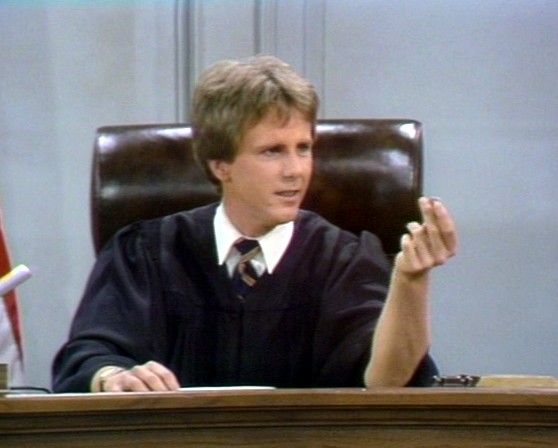
The world lost some of its magic with the passing of Harry Anderson. He looms large in the lives of the Sestras. When it comes to the original incarnation of "Must-See TV," the well both of us go back to time and again isn't The Cosby Show or Family Ties or Cheers. It's Night Court. And Harry Anderson is smack dab in the middle of that universe as the magical, big-hearted, Mel Tormé-loving magistrate Harry T. Stone. We're both Sestra Pros when it comes to that show, and we'd like to pay tribute to Anderson by scatting our way through our 20 favorite Harry-centric episodes.

All You Need is Love (Season 1, Episode 1): Harry Anderson’s appearances on Cheers made enough of an impression that NBC trusted him (and Night Court creator Reinhold Weege) with a spot in that coveted "Must-See TV" lineup. (Thank you, Brandon Tartikoff!) I’ll be the first to admit the first few episodes felt a little awkward. The blue jeans-and-denim-jacket look never worked on Harry and I definitely preferred the vintage suits and hats and neckties that became Harry Stone staples. Harry’s love for Mel Tormé was introduced in the premiere episode, much meaty material was generated from that connection and it never felt forced. On Harry T. Stone’s first night on the bench, he really came across as an immature, unprofessional, unstable judge. After all, he was deciding the fates of defendants before him with the flip of a coin! What we didn't know until the end of the episode was that he wasn’t relying on luck, he made each verdict utilizing a double-headed coin. Charming and disarming, that was Harry Stone. (~Leah)
Harry on Trial (Season 2, Episode 7): There were a few senior judges who never liked Harry’s unorthodox way of handling his courtroom. Judge Willard (Jason Bernard) was a particular thorn in Judge Stone’s side who refused to see Harry’s point of view that “a little levity never hurt.” (Wise words: I’ve used that line numerous times in my own career.) Judge Willard complained to the Judicial Review Board and Harry had to defend himself against accusations of unprofessional behavior. We got to see his court officers rally around him to try and protect his judgeship, although despite their good intentions, they almost sealed his fate. We also learned Harry goes above and beyond for defendants who need his help. Lucky for him judicial review board Judge Martin Landis – played with unlimited whimsy by Ray Walston – was on the same page as Harry and a happy ending was had by all … except Judge Willard and his dickie. (~L)

Nuts About Harry (Season 2, Episode 14): Harry Stone was the kind of guy who ordered sea monkeys out of comic books. He was described in this episode as an '80s kind of guy. That came in handy when four lovable psychiatric patients (James Cromwell and his talking hand, taller-than-Bull Kevin Peter Hall, silent Kate Zentall and the other one, Charles Bouvier) appeared before him in court. In a nutshell, the judge served as the straight man for rib ticklers like John Larroquette's "Can you say Dan?" exchange with Hall, but Harry really hit his stride when making an impassioned speech about P.T. Barnum's great egress to the gun-toting mute Ann. Anderson delivered his first jokes of the episode in a storage closet, but what really made it special was how he got through to her by picking up on her non-verbal cues. He got justice for all the loonies before we all got a reminder that we no longer hear "The Battle Hymn of the Republic" enough anymore. (~Paige)
Halloween, Too (Season 3, Episode 5): I suppose we were meant to consider Lana Wagner (Karen Austin), Billie Young (Ellen Foley) and Christine Sullivan (Markie Post) to be Harry's main love interests until Season 8, so the women guest stars spending time with the magistrate never posed much of a threat. Free-spirited Kimberley Daniels (Mary-Margaret Humes) was a horse of a different color, though. From the minute she ran into Harry sorting plastic snakes for a party in his office, Kimberley seemed like she possibly could be his soulmate, matching him quip for quip with the same wacky sense of humor that usually made his bailiffs roll their eyes. Well, at least she was until she was brought in front of him with Edna Sneer (Anne Ramsey in her trademark sandpaper style) for lewd behavior in Central Park. That might have garnered Kimberley a pass if she hadn't been crafting spells as a witch at the time. Harry wound up with a trick instead of the treat. (~P)
Wheels of Justice (Season 3, Episodes 9-10): It was only a matter of time before Harry would get a case that made him rethink his career in the first place. And we couldn't really blame the judge for getting upset when he had to rule in favor of a nasty landlord over a down-on-their-luck mother and son (Susan Ruttan and Harold P. Pruett). Having a teenage boy rail at him in court and call him "Pig" can really bring a guy down. Bumpkins Bob and June Wheeler (Brent Spiner and Annie O'Donnell with perfect delivery in their first appearance on the show) and their little pig-tailed daughter (Keri Houlihan) made things worse. But what made it all better was Dan Fielding's unexpected and strident speech to the former judge ... and Harry's hands-off payback when he rebounded enough to take the assistant DA's advice and get back to work and the public who needed him. (~P)

Leon, We Hardly Knew Ye (Season 3, Episode 16): Since the writers wouldn’t give Harry a steady girlfriend -- and don’t read into that too much, they didn’t give him a steady boyfriend either -- Stone decided to become a parent instead. He became a foster father to Leon, the shoe-shining orphan played by Bumper Robinson. Harry got to play Daddy for three episodes until a social worker arranged for Leon to be adopted by a professional but not-so-cool couple (“A bat and a puck??”) Leon went on to do what any self-suspecting at-risk youth probably would do in that type of situation: He put himself first and bolted, breaking Harry’s heart in the process. We really saw that Anderson could deliver the goods in a more dramatic way between quips. (~L)
Could This Be Magic? (Season 3, Episode 18): Harry always got excited when he saw a familiar face or famous person in his courtroom. Beyond running across his beloved Mel, remember his reaction to old friend Hacksaw (Andrew Bloch) in the pilot or the the international beauty contestants in the first season? So when his childhood hero, magician Philip Falcone (Carl Ballantine) wound up a defendant, Harry just had to help. He invited Philip to stay with him in his apartment. Falcone took advantage and utterly cleaned out Harry. I don’t know if the writers intended to use residual anger because this episode aired soon after Leon abandoned Harry. But you could count on one hand the times when Stone truly got pissed at someone. His ire was very apparent after Falcone gets arrested and hauled back into court, adding insult to injury by wearing one of Harry’s trademark suits (“It’s my fault ... for believing in you.”) I would curl up in the fetal position if he said that to me with so much contempt. Of course, Falcone saw the error of his ways and tried to make amends because Harry had that kind of positive effect on the people around him. (~L)
Hurricane (Season 3, Episodes 21-22): When Hurricane Mel threatened the New York metropolitan area, Stone was pretty excited. After all, he considered the storm to be named after his idol. But when Mel caused four women from a Lamaze class to go into labor, things got pretty hairy for Harry. It was all hands on deck as Dan dickered with an angry single mom (Pam Grier), Bull and Flo (Richard Moll and Florence Halop) tried to deal with an unnerved father (Dick Butkus) and Christine and the returned Wheelers kept pace with a human vending machine popping out triplets (Marcia Del Mar). Harry and Mac (Charles Robinson) got the worst of it, yuppies Babs and Chad (Rebecca York and James Widdoes). But after uniting the Ulins in matrimony by delivering their child while simultaneously signing the marriage certificate with a pen in his mouth as "Howie Stallone," Anderson wrapped up the two-parter in style, talking to God about the amazing miracles that happened on his watch. (~P)

The Next Voice You Hear (Season 4, Episode 1): Night Court suffered some horrible losses off screen that became integral parts of character development. Selma Diamond passed away after two years on the show and her replacement Halop died following her season. They were addressed perfectly by show creator Weege and Anderson in the first episode of the fourth season. After receiving a long-lost letter from his absent mother and finding out she too had passed away, Stone explained his non-reaction with poignant words about how he had lost the two bailiffs -- women who had been there for him and were more like family than just co-workers. How could he miss a mother he never knew the way he knew them? He learned to when stepfather Buddy Ryan (affable John Astin) told Harry about his mom, but what really got to me was the seamless way in which the show addressed losses of characters we loved almost as much as Stone did. (~P)
Dan's Operation (Season 4, Episodes 5-6): Let's not kid ourselves, the greatest love story on Night Court was between Harry and Dan (Come on, Leah already said not that way!) The characters were so diametrically opposed that they never got boring over the nine-season run and Anderson and Larroquette were so perfectly acclimated to their roles and in sync with one another that their reactions to each another livened up even the most mundane scenes. Credit the show for not turning the womanizing Fielding into a saint overnight, just bit by bit and season by season, he became a tad less offensive. When Dan needed an operation for his ulcer, it took Harry the bulk of a couple episodes to discover why he was so scared of the procedure. The duo followed the first parter's verbal tussle with the second parter's wordless reconciliation. Stone knew under all Fielding's crap was a decent human, and since he believed it, the rest of us could too. (~P)

Her Honor (Season 4, Episodes 21-22/Season 5, Episodes 1-2): The real gem of this four-parter (?!?) was the fifth-season opener. Stone lost his judgeship at the same time Christine was appointed to the bench. It's a plot twist you probably would expect. The way Harry reacted is what made Night Court one of a kind. After Anderson masterfully rode jet-powered skates through the cafeteria to so much audience applause Spiner's Bob Wheeler had to restart his next line -- "Don't worry, he's all right, the Girl Scouts broke his fall" -- Harry planned a big stunt. Sky rockets, a radar tracking system, rendered suet, AstroTurf, yak hair and three cases of ladies' dress shields get delivered to his apartment. Eventually Stone emerged in some kind of silver spandex superhero suit carrying a sack bigger than Santa's. The conclusion found Harry talking an inventor (Kenneth Tigar) out of suicide only to have the guy steal his stunt and hang glide to the Statue of Liberty, but what I still want to know was what the suet and dress shields were meant to be used for. (~P)
 Safe (Season 5, Episode 5): Five-plus seasons of Harry’s death-defying stunts and he almost got done in by Harry Houdini’s safe on his favorite holiday, Halloween. I'm not sure what the impetus was for series writer Tom Reeder deciding to shove Harry Anderson in a box for almost an entire episode and have the oxygen-deprived judge engage in a conversation with Jiminy Cricket "Let your conscience be your guide" Harry, but it worked. “Harry up and get me out of here!” he quipped early on in his stay. The kicker was that none of the show's regulars realized he was in danger -- except Art (Mike Finneran), who didn't count -- they just thought it was another one of Stone's pranks, obviously shades of "The Boy Who Cried Wolf." But it did curb Harry’s practical jokes, at least for a few weeks. ~L
Constitution (Season 5, Episodes 9-10): This was definitely an ensemble episode. In fact, the strongest scene didn't even involve Harry. But by this point in the series, Stone had perfected his role as leader of the chaos. There were more chaos than usual when diabetic Roz Russel (Marsha Warfield) quit her job, suffered from an insulin overdose and disappeared in the courthouse while the “founding fathers” served as defendants in a court case and an expensive special celebrating the 200th anniversary of the Constitution spiraled out of control. In the latter case, a TV director employed idiot dancers ("I get to carry the Constipitution!" ) and enabled a man who stole an original draft of the historic document threaten to burn it. Harry literally ran all over the courthouse – with the elevators out of service, of course, and "Skinny Butt" out of shape -- but still kept his wits enough to address everyone’s concerns and give Dan decent fashion advice. ~L
Safe (Season 5, Episode 5): Five-plus seasons of Harry’s death-defying stunts and he almost got done in by Harry Houdini’s safe on his favorite holiday, Halloween. I'm not sure what the impetus was for series writer Tom Reeder deciding to shove Harry Anderson in a box for almost an entire episode and have the oxygen-deprived judge engage in a conversation with Jiminy Cricket "Let your conscience be your guide" Harry, but it worked. “Harry up and get me out of here!” he quipped early on in his stay. The kicker was that none of the show's regulars realized he was in danger -- except Art (Mike Finneran), who didn't count -- they just thought it was another one of Stone's pranks, obviously shades of "The Boy Who Cried Wolf." But it did curb Harry’s practical jokes, at least for a few weeks. ~L
Constitution (Season 5, Episodes 9-10): This was definitely an ensemble episode. In fact, the strongest scene didn't even involve Harry. But by this point in the series, Stone had perfected his role as leader of the chaos. There were more chaos than usual when diabetic Roz Russel (Marsha Warfield) quit her job, suffered from an insulin overdose and disappeared in the courthouse while the “founding fathers” served as defendants in a court case and an expensive special celebrating the 200th anniversary of the Constitution spiraled out of control. In the latter case, a TV director employed idiot dancers ("I get to carry the Constipitution!" ) and enabled a man who stole an original draft of the historic document threaten to burn it. Harry literally ran all over the courthouse – with the elevators out of service, of course, and "Skinny Butt" out of shape -- but still kept his wits enough to address everyone’s concerns and give Dan decent fashion advice. ~L

Heart of Stone (Season 5, Episode 17): Harry started the episode by forcing Dan, Christine, Mac, Bull and Roz to become members of "The Bowling Stones" and showing off a ball that looked like a bloodshot eyeball on crack. But when Leslie (Jude Mussetter) showed up, he dumped his teammates in favor of getting it on with his college girlfriend back in his chambers. Harry covered Jean Harlow's eyes with a Post-It and gave a thumbs-up to his favorite picture of Mel Tormé before revealing what he wore ... or didn't wear ... under his robe. Problem was that Dan had a similar idea for nookie. To make a long story short, Stone and Fielding wound up standing on the ledge outside his office. It's another of those dynamic and hysterical episodes in which Anderson and Larroquette played off each other to perfection. And rest assured, even in just a codpiece Harry could make the peace between a wife (she was married??) and her husband. ~P
 Top Judge (Season 5, Episode 20): Harry started the episode by accidentally killing a senior judge, a double whammy because this judge understood Harry’s sense of humor, so he lost an ally too. To make matters worse, young judge Jimmy Cleaver (Gary Kroeger) -- even his name was annoying -- tried to steal Harry’s unofficial prankster title while he was in mourning. We learned Stone became a judge in the first episode because he was the only one home on a Sunday to take the call on the mayor's last day in office. But what mayor intentionally made the even-younger Cleaver a judge? I’ll admit I was suckered when Jimmy got the better of Stone in court -- how did he manage to make the whole bench disintegrate? – and Harry’s concession speech to Christine had me thinking he was OK with losing gracefully. But I should have had more faith in series writer Dennis Koenig. The Harry we know and love came through and easily put Judge Cleaver back in his place. And we never had to see Jimmy Cleaver again. ~L
Strange Bedfellows (Season 6, Episode 17): This one's primarily Dan Fielding's story, but it also featured the biggest and best of Mel Tormé's annual appearances. While Dan partook in a two-person "debate" in a hotel room with his opponent for political office, Harry tried to make amends to Mel after infecting him with a particularly nasty strain of the flu -- "the germs mated inside of me," Tormé moaned. Stone tried everything to make his hero comfortable, but the "Velvet Fog" wasn't having any of it. Nevertheless, we knew by now how persuasive Harry could be. He ended up posing for an accidental paparazzi photo with Tormé that every diehard fan could only dream of taking with his/her idol, although Harry probably wasn't quite as happy about the fact that the jazz singer threatened to hurt the judge with his own armadillo. I always think about what great fun this one must have been to film. ~P
Top Judge (Season 5, Episode 20): Harry started the episode by accidentally killing a senior judge, a double whammy because this judge understood Harry’s sense of humor, so he lost an ally too. To make matters worse, young judge Jimmy Cleaver (Gary Kroeger) -- even his name was annoying -- tried to steal Harry’s unofficial prankster title while he was in mourning. We learned Stone became a judge in the first episode because he was the only one home on a Sunday to take the call on the mayor's last day in office. But what mayor intentionally made the even-younger Cleaver a judge? I’ll admit I was suckered when Jimmy got the better of Stone in court -- how did he manage to make the whole bench disintegrate? – and Harry’s concession speech to Christine had me thinking he was OK with losing gracefully. But I should have had more faith in series writer Dennis Koenig. The Harry we know and love came through and easily put Judge Cleaver back in his place. And we never had to see Jimmy Cleaver again. ~L
Strange Bedfellows (Season 6, Episode 17): This one's primarily Dan Fielding's story, but it also featured the biggest and best of Mel Tormé's annual appearances. While Dan partook in a two-person "debate" in a hotel room with his opponent for political office, Harry tried to make amends to Mel after infecting him with a particularly nasty strain of the flu -- "the germs mated inside of me," Tormé moaned. Stone tried everything to make his hero comfortable, but the "Velvet Fog" wasn't having any of it. Nevertheless, we knew by now how persuasive Harry could be. He ended up posing for an accidental paparazzi photo with Tormé that every diehard fan could only dream of taking with his/her idol, although Harry probably wasn't quite as happy about the fact that the jazz singer threatened to hurt the judge with his own armadillo. I always think about what great fun this one must have been to film. ~P

From Snoop to Nuts (Season 6, Episodes 18-19): The sixth season was my favorite. The characters worked so well together and the writers truly hit the right notes for every one of them. To paraphrase Goldilocks and the Three Bears, this season felt “just right.” I’ve definitely quoted more episodes from this season than any other. Anderson double-dipped on this arc, he wrote and starred in the eps in which poor Stone suffered personal and professional crises of faith. I’ve always been curious to know whether the twist that Buddy was Harry’s real father was his idea or if the producers told him to incorporate it into the script. It took a bit of tap dancing to explain how that was possible, but I suspended my disbelief since Astin was so darn entertaining. When Buddy got serious, you couldn't help but listen to him. And drunk/hungover Christine was quite amusing, even if she almost got Harry killed (“Oh, I’ll bet Eddie gave her a Long Island iced tea.”) ~L

A Closer Look (Season 7, Episode 23): Anderson successfully completed the show trifecta -- acting, writing, directing -- when he took the reins for a whimsical look at the proceedings of the night court through the lens of a tabloid news program. Viewing the same sets we've been watching for seven years from different angles alone makes the episode feel completely fresh. M*A*S*H featured several episodes of journalist interviews with members of the cast as their characters to great effect and eventually our X-Files rewatch will get us to a successful Cops integration, but it truly takes a deft touch from all involved. This one does a great job of melding the idiosyncrasies of the characters with a unique look at the process of conducting their court after dark. As the television reporter Ed Druthers (Bob Sarlatte) perfectly summed up, Stone handled 134 arraignments, 15 trials, four jail sentences and sawed two defendants in half within the confines of this show. ~P
Alone Again, Naturally (Season 8, Episode 17): It only took eight seasons, but the writers finally gave Harry a girlfriend who lasted more than one episode. Unfortunately, Margaret Turner was played by Mary Cadorette, best known for starring with John Ritter in the extremely disappointing Three’s Company spinoff, Three’s a Crowd. Although she was introduced in a His Girl Friday-like manner that surely would have appealed to retro-loving Harry, Margaret didn't seem particularly likable and the writers really didn’t give her much of a chance to win over audiences with only four episodes. But, like in real life, when your friends are with someone they love you just want them to be happy. So I couldn't help but feel badly for Harry when he was about to propose marriage to Margaret and ended up losing her forever to the Witness Protection Program. I’ll never listen to Marvin Gaye and Kim Weston’s "It Takes Two" the same way again. ~L

Opportunity Knock Knocks (Season 9: Episodes 20-21): Even though "The 1992 Boat Show" aired out of order after this one, this was the series finale. Christine was elected to office and Dan decided to follow her to Washington, D.C. Even Harry was looking at potential career choices, one of which involved touring with Mel! But during his last case with Christine and Dan, Harry met two elderly musicians whose songs provided him with rare, touching memories of his mother and childhood. The young and inexperienced Judge Stone who once yelled “Hacksaw?!” across a crowded courtroom had been replaced with the older and wiser Judge Stone who presided with respectful awe over the feuding defendants before him. For this last case, Harry worked his magic and the partnership was saved. And in turn, Stone realized the magic in his own life was in night court. ~L
We kind of wish we could have stayed in Night Court too, but thankfully we have the nine seasons to look back at and laugh and cry over. Watching Harry Stone talk about death right now hits a little too close to home, but listening to the words he was saying with all the emotion he put into them with does help. Thanks for the chuckles, Harry, this way to the "great egress."
Sestra Amateur:
 Paramedics are racing to a Pittsburgh hospital with a man who suffered cardiac arrest. Paramedic Leonard Betts, played by the always-entertaining Paul McCrane -- now there’s a man who should be working the convention circuit -- briefly saves the patient’s life. Unfortunately, their ambulance gets T-boned and Leonard loses his head over it. I’m not talking figuratively; it’s completely severed from his body. His lucky partner, Michele Wilkes, walks away with just a few scratches. Looks like Betts isn’t OK with being dead. His headless body gets up, clocks a morgue attendant upside the head then wanders away. How can he see where he’s going?
 Sculder are called to the scene. Maybe they can wrap up this one quickly and catch a Penguins game. Nope, looks like they played the Sabres in Buffalo when this first aired on Jan. 29. 1997. Dana thinks Leonard’s body was stolen for profit. Fox disagrees. Security footage conveniently obscures the head area with visual snow. Our heroes root around in a drawer of medical waste and find Betts' head. Scully autopsies it and clearly he’s a miracle of modern medicine -- he looks normal and healthy, especially when he opens his eyes and tries to talk. Go ahead and explain that one away, Dana. No matter what you say, it will sound like you’re in denial.
Meanwhile Fox goes to Leonard’s apartment, where the bathroom looks like a crime scene. I don’t even want to guess what that tub full of brownish-red water is supposed to be. I’m surprised Mulder didn’t drain it to see if anything was hiding in there. Think about it, Fox, if there was a body in there, it wouldn’t need to come up for air without a head, right? Scully calls Mulder to let him know her PET scans have been unsuccessful due to some type of radiation affecting the images. She partially explains away Betts' movements but doesn’t give Fox the whole story. By the way, care to guess where Leonard was hiding? Looks like he’s growing a new head too.
 Paramedic Wilkes tells Mulder about Betts' gift for diagnosing people with cancer. Prior to the accident, he was never sick or injured. He’s David Dunn from Unbreakable until he, you know, broke. Dana continues testing Leonard’s original head and allows a pathologist to view a slice of the brain. They learn poor Betts was riddled with cancer. Wilkes goes back to work, but she zones out during a medical call when she thinks she hears Leonard on the radio diagnosing a patient. Wonder what that’s about. Maybe there’s a third head in the mix, but I guess he would need another hand to work the radio.
Sculder go all the way to the University of Maryland to have scientist Charles Burks analyze another slice of Betts' head, this time via the use of aura photography. The image shows a shadow of the body, similar to Dr. Burks’ description of a lizard showing the aura of its severed tail. Luckily, Dana doesn’t try to explain away this result. Fox tells her he found iodine in Leonard’s apartment that has been used for limb regeneration in salamanders. Mulder suggests the cancer-ridden form is Leonard’s normal stasis.
Leonard Betts’ fingerprints come back to a man named Albert Tanner. The agents meet with Albert’s mother, Elaine, and see a picture of Leonard on her table. Apparently, Albert died in a car accident six years earlier. Guess we know what Leonard’s kryptonite is. Wilkes goes looking for the man who sounded like Betts and learns he’s the new paramedic on the block. Isn’t it weird how you can regrow your head at least twice and still suffer from male-pattern hair loss?
 Leonard kills Michele to keep his secret. He tries to run from a security guard, who tackles Leonard and handcuffs him to a car door handle. Looks like Betts can also grow a new thumb. After learning Wilkes was killed with an injection of potassium chloride, Sculder find cancerous medical waste in the trunk of Betts' car. Mulder thinks it's sustenance for Leonard. After all, a regrowing boy has to eat. As it turns out, it’s Elaine Turner’s car.
Back at Elaine’s house with a search warrant, Mom Tanner doesn't buy Scully’s claim Leonard committed cold-blooded murder, since God has a purpose for him. Betts goes to a bar to kill time while his thumb continues to regenerate. He follows a man outside who presumably has lung cancer and takes what he needs. Afterward, Betts regrows another head which comes up from inside his body and out his mouth. The extraordinarily cheesy special effects don’t help that scene at all. At the same time, Sculder find Leonard’s storage unit, the now-dead lung-cancer man (not to be confused with Cancer Man) and Betts, who tries to run them over with his car. Fox shoots and Leonard’s car bursts into flames.
Sculder argue while standing over Leonard’s charred corpse. Mulder still thinks Betts and Tanner are the same person. Scully doubts it, so they exhume Albert’s body, which is still in the casket. Mulder thinks there is still a live version of Leonard Betts out there somewhere. And he’s right, Elaine Tanner is bathing Leonard in iodine. Makes you wonder about Betts' father, doesn’t it? Fox and Dana stake out the Tanner home until paramedics show up. Thinking it’s Leonard in the ambulance, they hold the medics at gunpoint until they learn the call came for Elaine. Guess she had cancer because Leonard removed something from his mother’s chest.
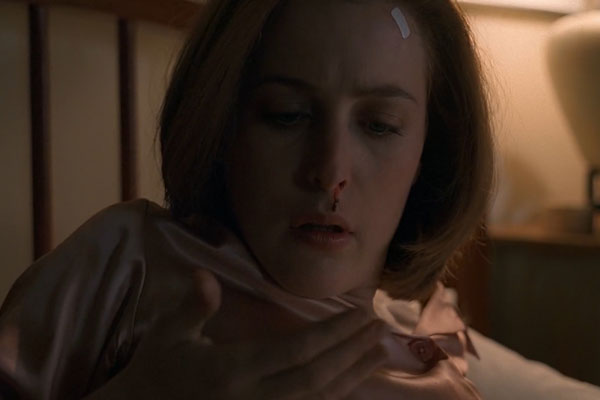
 Scully rides with Elaine and the paramedics to the hospital, then realizes Betts hitched a ride too. Leonard claims Scully has something he needs – does Dana have cancer?? – then attacks her. She manages to fight him off with some decent kicks inside a closed ambulance. He punches her but Scully charges the paddles and kills him with a zap to the head. Mulder drives them home, but Scully wakes up in the middle of the night with a nosebleed ... at least we know Gillian Anderson is going to get some meaty material in future eps.
Now let’s discuss suspension of disbelief. I think I’ve been pretty liberal with it considering this is a show about unexplained phenomena. But the timeline of this particular episode can’t be more than a few days because Michele Wilkes has visible injuries from the ambulance crash at the beginning of the episode. So, over the course of a couple of days, Leonard establishes yet another alter ego – also a paramedic – gets credentials and falsified EMT certifications, completes an employment application and interviews, gets hired and immediately goes back to work at another Pittsburgh hospital without a trainer for his observation/probation period? Can you imagine any reputable medical transport company taking on those liability issues? I’ll believe Leonard coughed up yet another head before I’ll believe that.
Sestra Professional:
Sestra's Am's problems with suspension of disbelief aside, this episode had everything -- back story, a monster of the week, plenty of scares, cool quips courtesy of a trio of regular writers and the dramatic twist at the end. But that's not why "Leonard Betts" was the highest-rated show of all time. It aired right after the Super Bowl in 1997 and picked up an estimated 29.1 million viewers.
 "We knew we'd get a huge audience," co-writer Vince Gilligan said in The Complete X-Files. "Chris really wanted to grab viewers who had never seen us before, and we knew the best way to do that would be with a really creepy stand-alone monster story."
But just remember -- to mash Rudyard Kipying with Jeff Foxworthy -- if you can keep your head when all about you are losing theirs, you may be an X-Files fan. Of course, back during the original run, social media was basically message boards and mailing lists, so there wasn't quite the same reaction to each and every episode that we've seen in the two revival seasons.
I don't even know how to respond to that: Nevertheless, actually "Leonard Betts" probably would be considered under the radar of most X-Philes. It's a real wheelhouse episode, but it moves next week's Scully-centric "Never Again" behind this one. Gillian Anderson has long held that she would have made different acting choices during filming for that one had she known what was coming at the denouement of this one.
 It's a phenomenal and another underrated guest performance by Paul McCrane (who I knew best from Fame, but later became well known for roles on 24 and E.R.) He really gets to do it all as the many incarnations of Turner/Betts. And we thought Cigarette-Smoking Man had a lot of lives. This might have been around the time we stopped calling Smokey "Cancer Man" and started sticking with CSM.
I'm sorry, but you've got something I need: We're heading into a key run of Scully episodes, and it winds up starting here with one filmed after a couple of others we haven't seen yet. It wasn't just the Super Bowl opportunity that changed the landscape. Darin Morgan bowed out of his expected script so Gilligan, Frank Spotnitz and John Shiban reportedly whipped this one up based on a few old ideas and a couple of new ones. Spotnitz had broached the idea of Dana having cancer the previous season, according to the official fourth-season episode guide. It was tabled then, but fit pretty seamlessly into the tableau at this point.
Scully seems pretty unconvinced about what she's actually seeing throughout the episode, but she still works hard to make or break the case with science. And then she gets to save herself for a change, finally killing Betts in a way Mulder probably wouldn't have thought of in the same situation.
 I think I got the toy surprise: Fox, who looked more uncomfortable handling the surgical remains than he has been since getting bile on his hands way back in Season 1's "Squeeze," is left to hazard the guesses that all of us were making while watching the show. His theory about evolutionary advances being more cataclysmic and less gradual is a little over my pay grade, though. Dana seems beside herself more than usual and she draws the best reaction shots, but at least Mulder gets the best banter (i.e., telling the pathologist examining the brain that they wanted "a slice to go.")
Meta with Frank Shigan: A character named John Gilnitz becomes a hallmark of episodes written by Gilligan, Spotnitz and Shiban. The hapless soul in this one is one of Betts' victims. ... According to the episode guide, the faculty of the prestigious Berklee School of Music was so knocked out by Mark Snow's score for this episode that they asked him to focus his guest lecture on the seamless changes of mood and tempo from the opening teaser. ... And it doesn't play so well now, but the shot of Leonard's new head emerging from the old one actually netted Emmy nominations for the show's special effect supervisor Toby Lindala and key makeup artist Laverne Basham.
 Guest star of the week: All Betts are off, McCrane, by a head! Actually by a whole body. The veteran TV-movie actor gets to play both hero and villain and really pulls it off. On top of that, I particularly marvel at scenes like the autopsy when Scully is coming at him with a scalpel or the heavily made-up Betts emerges from the tub with iodine liquid in his nose and mouth. We can see via the gag reel that it wasn't so easy.
Sestra Amateur:
I hope this is a one-and-done bottle episode. The monster-of-the-week ones are always so hit-or-miss. This one opens on an old lady named Flakita telling a story to young immigrants about migrant workers in San Joaquin Valley, California. One of the workers, Soledad, is jealous because his girlfriend, Maria, is flirting with another immigrant, Eladio. Her inattention causes Flakita’s goats to escape, so Maria and Eladio run after them. There’s a weird light, then weird yellow rain like a sulfur storm. Some of the goats return, but Maria is dead in the yellow water, her eyes and mouth burned away.
Three days later, Sculder are on the scene for their investigation. Not sure how much time has passed since the events of "Paper Hearts" (S4E10), but Mulder doesn't seem to have been suspended or fired for his actions that resulted in the kidnapping and terrorizing of an innocent little girl. Fox tells Dana about fortean events, apparently they come in several colors, not just yellow. And why has no one burned or buried that goat yet? Good thing they didn’t leave Maria out there too. The migrant workers assume the agents are with the Immigration and Naturalization Service and bolt. Flakita blames Maria’s death on El Chupacabra -- but shouldn't that be "El Chupacabro" or "La Chupacabra?" Soledad thinks Eladio killed Maria. We also learn Eladio and Soledad are brothers. Scully and Flakita share the same theory -- typical love triangle soap-opera drama. Is that why this episode is called "El Mundo Gira," which translates to The World Turns?
 Mulder -- who definitely comes off as The Young and the Restless -- goes to the INS office in Fresno for information. He meets with Agent Conrad Lozano, played by character actor Ruben Blades. Fox hits a roadblock when Lozano points out that none of the migrants give their real names to INS agents. Conrad believes Eladio killed Maria and the stories related to El Chupacabra are just stories. Scully -- The Bold and the Beautiful -- goes to the coroner’s office to autopsy Maria’s body, but three days in a body bag really cemented the effects of the “fortean event.” She looks like Stephen King after he was exposed to the meteorite in Creepshow. Cause of death: Massive fungal infection.
Conrad tells Fox that Eladio is in custody under the alias Erik Estrada. "Erik" denies killing Maria and describes the thunder, lightning and hot rain from the incident. It sounds like he’s talking about the Three Storm characters in Big Trouble in Little China. Eladio recalls Maria lying in the puddle of yellow rain with part of her face eaten away. He gives a statement that could win him a Daytime Emmy and is bused to his court hearing. After updating each other on the case, Sculder stumble across the crashed court-bound bus. Migrant workers running everywhere! They’ll be harder to corral than those goats. Turns out the bus driver died from a different fungal infection. Agent Lozano arrives and tells Mulder and Scully that most of the escapees were recovered, but not Eladio. He's trying to get a ride back to Mexico, but settles for day labor work.
 Dana seeks assistance from Dr. Larry Steen at California State University in Fresno (General Hospital and Port Charles are based in New York, so that wouldn’t have worked at all). The bus driver’s fungal infection was an accelerated version of athlete’s foot. Dermatophytosis Gone Wild. This also fits Dana's theory about Maria’s exposure to pesticide. Eladio starts to feel ill at the job site. Soledad arrives and thinks Eladio is in the Port-a-Potty. Instead, he finds Eladio’s fungally infected dead boss. Eladio takes off in the boss’ truck to see his cousin, Gabrielle. Scully warns Mulder about the contagion, right about the time he and Lozano find Port-a-Potty Boss.
Fox is still trying to prove his Another World theory about the fortean event, but Dana's a little too busy to entertain his perspective. Mulder and Lozano get a tip that Eladio's at a nearby truck stop. They chase him but Eladio gets away in a truck full of goats, which -- of course -- later turn up dead. Really, Eladio, what did those goats ever do to you?
 Flakita is brought to the scene of the dead goats and points Sculder and Lozano in Gabrielle’s direction. Looking very ill, Eladio, goes grazing in the nut aisle of a grocery store but panics and accidentally knocks over the bulk-food dispensers when the stock boy yells at him. Too bad that the stock boy touches some of the now moldy nuts. Eladio calls Gabrielle and learns Soledad is coming after him. Sculder and Lozano follow Soledad into the store and they have a standoff at gunpoint. Soledad justifies his need for vengeance against his brother. He gives himself up, but Dana is distracted by the dead stock boy in the nut aisle. Poor kid had but One Life to Live and now it’s gone.
Eladio goes to Gabrielle’s apartment, but he’s physically changed so much she really thinks he’s El Chupacabra. Gabrielle pays him to leave her alone and tells the agents Eladio is going to Mexico, but Mulder is convinced Eladio is going to see Soledad at the holding facility. Right idea, Mulder, but wrong location. Lozano takes Soledad back to the migrant camp in San Joaquin (which is approximately 220 miles from … Santa Barbara ... and they confront Eladio. There’s a chase and an off-screen gunshot. Afterward, Flakita finds Lozano’s dead fungal body. She sees a Guiding Light in the sky then several forms who look like fake alien extras from "Jose Chung’s From Outer Space" (Season 3, Episode 20).
 Flakita thinks they were more Chupacabras who arrived to help Eladio and claims Soledad is being punished for his actions. The people listening to her story call BS because Gabrielle told them a different version of what happened. The story goes back to show Lozano and Soledad were chasing Eladio when Conrad fired a warning shot in the air. Eladio stopped running and Lozano gave the handcuffed Soledad his gun to get vengeance for Maria’s death. Eladio completely transformed into El Chupacabra, so Soledad wussed out and refused to kill Eladio. Conrad and Soledad struggled over the gun which went off again, killing Lozano. According to Gabrielle, Eladio and Soledad ran off together to Mexico, maybe to reunite with their parents. (I’m sure there’s an All My Children reference in there somewhere.)
Back in the Capitol, Sculder give assistant director Skinner a verbal report of their investigation. (Loving the fact that they added Walter for a brief appearance, even if it is only for the epilogue.) The “Chupacabras” Flakita saw were members of the Hazmat team Scully called to assist them. Eladio and Soledad’s last victim was the local barber, the greedy man who got them into the United States from Mexico, the man to whom Eladio turned to for help to return to Mexico, the man who gave up Eladio’s location to Sculder and Lozano. Why are the men are still at large? Dana points out that immigrants can be considered “invisible.” Fox bluntly says nobody cares. Of course, Sculder will also forget all about these guys and start a new case because, “like sands through the hour glass, these are the Days of our Lives.”
Sestra Professional:
One and done sounds good to me. The bottle episodes may be hit-or-miss, but the animal-referenced stand-alones tend to miss. Witness the likes of the zoo gone wild in "Fearful Symmetry" (S2E18), the mother of all X-Files clunkers -- "Teso dos Bichos" (S3E18) -- and others that happen later in the rewatch. We can give special dispensation to "War of the Coprophages (S3E12)" -- the comedy episode about cockroaches -- and "Quagmire" splits into two parts, the shippery goodness of "Conversation on the Rock" and the rest involving an alligator/the U.S. version of the Loch Ness monster.
 The aliens in this story are not the villains, they're the victims: Writer John Shiban's teetering over more than the Edge of Night. There's a viable plot in here, it's just buried underneath the layer of "the oldest story in the world" -- two brothers plus one woman equal trouble. Shiban hits the "immigrants are the real aliens" aspect a little hard, but what works far better is Lozano's reaction to Mulder's own take on the case -- "So you got your own stories too."
I also buy the concept that the fungi spreads via this enzyme from pesticide fertilization courtesy of a brother or two who may be immune. So with all the things the script has going for it, why isn't this a better and/or more popular episode? Maybe it's just too much soap opera -- which certainly doesn't hold up well out of context since it's already a ham-fisted parody of romance stories -- for a love story we know and care little about. Then there are the cultural stereotypes being reinforced that weigh down too much of the proceedings.
 But Scully is indeed both bold and beautiful in this episode. Yellow rain must become her. Meanwhile, Fox is having a tough time trying to shoehorn in his supernatural theories, particularly when Dana's proving out her assumptions through science. The best we can get is apparently a Prince quip made for an episode that first aired in January 1997 about a movie from 1984. Maybe he just got around to renting it at Blockbuster.
So high marks to the show's makeup and hair people for having Scully come off like some kind of supermodel at the migrant farm and in the autopsy room. Also big ups to Toby Lindala and the art department for the effects caused by the fungi, particularly on the decomposed bodies. I needed a Silkwood shower after just watching for fear of picking up the contagion.
 Frankly, I'm confused by this story: The ending seems a bit muddled -- as does the choice to morph El Chupacabra alien graffiti into Skinner's head. I appreciate the multiple versions of the story being told by the migrant community since that's how their tales will ultimately live on and be expounded upon, with precious little of the actual truth contained within. I'm not quite sure I buy Flakita turning all Team Mulder with her tale of more grey Chupacabras coming down in a flash of lightning, even with the subsequent explanation of the Haz-Mat team.
I should have saved 'Meta me mucho' for this week: In the official fourth-season episode guide, Shiban said the seeds for the story were sown when he worked as a computer programmer north of Los Angeles. He'd see long lines of migrant workers in the strawberry fields along the freeway every day, but never really considered their situation. ... Scully mutters "Maria, Maria, I just met a woman named Maria" from West Side Story when leaving the migrant camp. ... Executive producer Chris Carter was a huge fan of Ruben Blades and had been looking to get the musician/actor/politician on the show for a long time, according to the guide. ... The guide added that this show marked the first time Mark Snow's originally submitted score was rejected. He then added a dash of Spanish flavor via flamenco guitar and a tango.
 Gillian Anderson's young daughter, Piper, who worked in the art department during the show's revival, was fascinated by the fuzzy corpses on the set that week. "Piper calls them 'yucky guys'," Anderson recounted in the episode guide. "In one of the scenes in that episode the yucky guy was actually a mannequin. ... Piper went up to it and said, 'You OK? You OK?' He didn't answer, so she started singing 'Itsy Bitsy Spider' to him. It was hysterical."
A man can not live with vengeance in his heart: I'm quite certain The X-Files was not planning for the Season 11 capper "My Struggle IV" with the violence-bent line back in the much-maligned "El Mundo Gira," but it certainly seems like a callback -- or is that a callforward? -- considering the heavy casualties stacked up in the latest possible series finale. This offering's greatest gift will ultimately be as a couple throwaway lines in one of next season's best eps.
 Guest star of the week: Blades elevates the material as much as it's able to be elevated. He makes Lozano much more interesting than the traditional nay-saying agent who stares in disbelief at Mulder's wilder theories. Too bad he had to go out with the yellow soapy bathwater. This guy is definitely better than Erik Estrada.
Sestra Amateur:
I had some concerns going into this one. There are a handful of X-Files episodes I’ve seen more than once, and of those, there are a few I thought I loved. Part of me worried I would look at "Paper Hearts" through cynical eyes and see the same old forced-plot contrivances -- all the scenes involving lack of cell-phone communication to move along a story or bonehead, out-of-character choices that really, really question the almighty suspension of disbelief needed to enjoy a show like The X-Files in the first place (Looking at you, "3.")
I can say "Paper Hearts" contains my favorite piece of Mark Snow music -- an uplifting, mystical lullaby called "Watergate Hearts." I remember being very disappointed it wasn’t included on the first soundtrack and wasn’t available outside of the episode. Forget calling it "Watergate Hearts," for me, it's "Dot’s Theme," because we only get to hear it and enjoy it during the "red dot" scenes. What are "red dot" scenes? I’m glad you asked.
 Mulder seems to be enjoying a restful sleep when he sees a red dot moving along his wall and ceiling. Dot tells him to “Follow” and leads Fox to Bosher’s Run Park in Manassas, then flashes the words “Mad Hat.” Mulder tracks Dot into the woods to the body of a dead little girl, then the light turns into a heart and she sinks into the ground. Fox wakes up, locates the park in the phone book (remember those?) and follows the path he saw in his dream to the site. Mulder calls for an excavation and a body is found. Fox puts the evidence collection at risk to speed up the excavation, but he professes to already know who the killer is: John Lee Roche, a man already incarcerated for killing 13 girls.
Roche, played by character actor Tom Noonan – who I know best as Cain in Robocop 2 and Francis Dollarhyde in Manhunter – admitted to the murders. So why didn’t he admit to No. 14? Scully identifies the corpse as Addie Sparks who went missing in 1975 and our heroes then inform her father of the news. The agents track John Lee's former car, an El Camino, in attempt to find his missing trophies. Mulder keeps seeing “Mad Hat” via Dot and looks for the vehicle’s camper shell. He finds a copy of Alice in Wonderland (Mad Hatter, ahhh.) Inside the book are 16 hearts cut from the material of the girls’ clothing. (Is Cotton Hearts more accurate? Cotton/poly-Blend Hearts?) Now Sculder need to identify and locate the other two girls.
 They visit Roche in prison -- Dana properly refers to them as cloth hearts. John Lee is flippant with his responses, but agrees to tell Fox everything if Roche can have his trophies back. Later that night, Mulder is mulling over the evidence when Dot appears again. (Cue "Dot’s Theme.") Dot leads Fox into the past, to his sister and a night of Stratego and Watergate news coverage. Mulder's relives an argument with Samantha about what to watch on television, but instead of an alien abduction, Fox watches John Lee kidnap Samantha. Is one of the unidentified victims his own sister?
The next day, Mulder confronts Roche, who claims he sold William Mulder a vacuum when the family lived in Martha’s Vineyard in 1973. (Bill, no woman wants appliances as a present, I think that killed your marriage more than the secrets.) John Lee pushes Fox's button one time too many times, so Mulder belts him in the face. The guard “didn’t see” it, but Scully did outside the interview room. Fox thinks Roche knows what happened to Samantha, but Dana learns the convict accessed the prison internet the previous day, probably to mess with Mulder’s head. Funny how Scully doesn’t believe Samantha was abducted by aliens, but she doesn’t believe John Lee killed her either, even though that is the more plausible of the two tales.
 Mulder goes to his mother’s house to see if she recognizes the material on the cloth hearts from one of Samantha’s night gowns. She can’t say for sure, but she does still have the crappy 23-year-old vacuum cleaner in her basement – the same brand Roche claimed to sell to Fox’s father. Considering how cluttered and disorganized the Mulder family basement is, I’ll allow this teeny bit of plot contrivance. Maybe Teena really left it down there for a couple of decades. Upstairs she probably uses one of those useless carpet sweepers.
Assistant director Skinner revokes Fox's access to Roche. Did Scully rat on him for hitting Roche? Of course not, I can’t believe you even thought that was a possibility. It happened at one of those prisons that uses video surveillance. Dana backs Mulder’s belief that John Lee is a viable suspect in Samantha’s disappearance. Walter does the stern boss thing, then let’s them get back to the investigation. Back at the prison, Fox shows Roche the two unidentified hearts.
 John Lee accurately describes the scene of Fox and Samantha watching TV and playing Stratego back in 1973. He offers a deal: Mulder picks a heart and Roche will tell him where that body is buried. There’s a 50/50 chance it will be Samantha. This brings us to another forced-plot contrivance: Wouldn’t Mulder have had the hearts tested to see whether there is the presence of DNA and wouldn't that already have been tested against something of Samantha’s? DNA plots are alive and well in the X-Files mythology and I refuse to believe Teena would save the world’s oldest, ugliest vacuum cleaner but none of her abducted daughter’s possessions.
John Lee directs Sculder to West Virginia where Fox finds a tree with the words "Mad Hat" carved into the base. Mulder starts digging with his hands – seriously, no shovel? Did you think the body would be out there sunbathing for 23 years? Clearly consumed by the obsession, Fox digs until he finds a girl’s body with a heart cut out of her nightgown.
In the morgue, Mulder quickly realizes the girl is not his sister. He brings the last cloth heart back to John Lee, who tries to use the body’s location as leverage for a day pass to the burial site. Scully isn’t buying it. Unfortunately, Fox does and he springs Roche. They board a plane to Boston where John Lee creepily chats up a young female traveler and her mother. At Martha's Vineyard, Roche describes what happened the night of Samantha’s disappearance, but Mulder finally has the upper hand -- it’s the wrong house.
 Fox sounds insane as he claims John Lee has somehow gained access to his memories and dreams. Later that night, Mulder is in the hotel room while Roche sleeps peacefully. (He really didn’t think this one through. You’ve got to sleep sometime, Fox.) Mulder hears Samantha calling to him for help. Outside the window he sees his sister in John Lee's El Camino. Adult Fox unlocks the car door and saves Child Samantha. Dot appears, tells Mulder “Bye” and his sister and the car disappear. Fox wakes up to Dana and Walter banging on the hotel door. Roche is long gone and Mulder is handcuffed. Now, that’s just embarrassing. At least John Lee didn’t take Fox's badge, gun and cell phone. Uh oh…
Mulder surmises Roche went after Caitlin Ross -- the girl on the plane -- with the stolen identification. This abduction is on you, Fox. He narrows down their location to an old bus storage yard. Luckily Mulder still has his spare gun. He hears Caitlin scream and finds them in the back of a bus. Fox thinks John Lee is about to shoot the girl, so Mulder takes Roche out first.
 Back at FBI headquarters, Scully tells Mulder they’re unable to identify the final victim so the episode ends pretty bleakly. Even my mystical lullaby has been replaced with somber music. Mulder should have been suspended without pay, fired and maybe even charged with manslaughter. (Before you argue he saved Caitlin’s life, it was Fox’s criminal action that put her in danger in the first place.) On a lighter note, did anyone notice Dana's FBI ID badge? It’s a side profile glamour shot that makes Scully seem less like an FBI agent and more like Gillian Anderson playing an FBI agent on TV. So I guess in that respect, it’s pretty accurate. "Paper Hearts" remains a favorite, despite the demerits on my plot-contrivance grievance list. And I'll play myself out on "Dot’s Theme" so I can end on a high note.
Sestra Professional:
"Paper Hearts" was a game-changing episode on The X-Files landscape. It gets underway with the mind-boggling premise that Samantha's abduction was not part of the alien conspiracy. And that's carried out with such steely resolve that you believe it for 40 minutes or so. Not only that, you kind of want to believe.
 How is that possible when we've spent more than three seasons investing in the idea of the mythology? Give all due credit to writer Vince Gilligan, who strayed far off the path -- but not in a Darin Morgan-esque alternate universe-type way. Save some kudos for David Duchovny, who delivered his best performance to date (and probably his finest for the entire series) and guest star Tom Noonan (so creepy, and most of all, convincing as Samantha's possible abductor).
Helping him detail: The opening scene is a marvel. As Sestra Am mentioned, Mark Snow's "Watergate Heart" (aka "Dot's Theme") sets an unusually light tone until Fox finds exactly what the Red Dot is leading him to in the woods. There's none of the usual machismo emanating from Mulder, we're on the journey with him as though we put on shoes and followed him into the forest. Usually there's a beat that enables us to approach Fox's theories with a measure of Dana's trepidation, but not so to start here.
"Paper Hearts" gives us an intriguing look back at Mulder's past history as a profiler. It's being filtered through his present patented X-Files' I'll-do-what-I-want-when-I-want bent, but we certainly can go along with his suppositions about Roche's crimes. Even though the methods may leave something to be desired, his heart is in the right place.
 The episode advances Fox and Dana's relationship as well. Early on, Scully echoes Mulder's earlier sentiment from "Aubrey" (S2E12) of a dream being "an answer to a question we haven't yet learned how to ask." She's not just paying him lip service. There's a nicely crafted exchange in which Mulder asks Scully whether she really believes his sister was abducted by aliens. That scene more than any weighs the scale in John Lee's direction. And later, there's the poignant moment at the crime site when all of Dana's investigative instincts are laid bare by Fox's request for help, followed by a nice moment in the autopsy room when he realizes the body he found couldn't be Samantha.
I got nothing to gain: The use of "Alice in Wonderland" imagery is blatant, but we're not really hit over the head with a fairy-tale sensibility. Gilligan's truly treading the fine line perfectly while building on a motif he introduced in "Pusher" (S3E17). The Mulder-Roche dynamic isn't too far afield from the one Gilligan penned between Fox and Robert Patrick Modell, the dying murderer who drew Mulder into a game of Russian roulette.
The episode advances Fox and Dana's relationship as well. Early on, Scully echoes Mulder's earlier sentiment from "Aubrey" (S2E12) of a dream being "an answer to a question we haven't yet learned how to ask." She's not just paying him lip service. There's a nicely crafted exchange in which Mulder asks Scully whether she really believes his sister was abducted by aliens. That scene more than any weighs the scale in John Lee's direction. And later, there's the poignant moment at the crime site when all of Dana's investigative instincts are laid bare by Fox's request for help, followed by a nice moment in the autopsy room when he realizes the body he found couldn't be Samantha.
I got nothing to gain: The use of "Alice in Wonderland" imagery is blatant, but we're not really hit over the head with a fairy-tale sensibility. Gilligan's truly treading the fine line perfectly while building on a motif he introduced in "Pusher" (S3E17). The Mulder-Roche dynamic isn't too far afield from the one Gilligan penned between Fox and Robert Patrick Modell, the dying murderer who drew Mulder into a game of Russian roulette.
 One of my favorite scenes of the entire run -- and one unencumbered by plot contrivances -- shows Fox as an adult reiterating the dialogue we saw delivered by his younger self in "Little Green Men." In David Duchovny's voice, Mulder's words are older, more wary and slightly astounded to be reliving the childhood trauma. And then the bright lights flood the room and the door opens to reveal Roche, not the little grey men he's always accusing of having nabbed his sister. And he's powerless again.
That's geography, man, it's just geography: I've never really thought the episode needed to hang the Mulder-Roche connection on a "nexus" somehow created when Fox profiled John Lee. I suppose that's what the "Red Dot" represented and since it was an X-file, it needed some kind of supernatural bent. It seemed more likely that Scully was right about Mulder being right about dreams and that Roche learned details from Fox's interviews on the subject in the prison library.
One of my favorite scenes of the entire run -- and one unencumbered by plot contrivances -- shows Fox as an adult reiterating the dialogue we saw delivered by his younger self in "Little Green Men." In David Duchovny's voice, Mulder's words are older, more wary and slightly astounded to be reliving the childhood trauma. And then the bright lights flood the room and the door opens to reveal Roche, not the little grey men he's always accusing of having nabbed his sister. And he's powerless again.
That's geography, man, it's just geography: I've never really thought the episode needed to hang the Mulder-Roche connection on a "nexus" somehow created when Fox profiled John Lee. I suppose that's what the "Red Dot" represented and since it was an X-file, it needed some kind of supernatural bent. It seemed more likely that Scully was right about Mulder being right about dreams and that Roche learned details from Fox's interviews on the subject in the prison library.
 Like Modell in "Pusher," Roche has a way with words. The way he details choosing a victim because a customer decided not to buy his vacuum chills us to the core. He's almost as good as Fox at recounting the night Samantha disappeared and he wasn't even actually there. And he's got a point about Mulder being OK as long as he can believe in flying saucers. (The twirly UFO noise Noonan supplements that with is priceless.)
Fox does fly in the face of procedure a lot. I guess that's glossed over because John Lee will never get out based on the crimes he's already been convicted for. Roche's never getting out, right? (Well, except for the little detour to Martha's Vineyard.) It's a little bizarre that Scully seems to suffer more recrimination for Mulder's actions than he does within the confines of the episode.
Meta me mucho: Keen eyes will note the remaining cloth hearts don't match the nightgown worn by Samantha in this episode nor from Mulder's abduction flashback in the second-season opener "Little Green Men." ... Noonan told me at X-Fest 2018 that Duchovny sunk his basketball shot on the first try and the former Princeton player made two of three on subsequent takes. Noonan added that he made all of his own shots, but the show didn't want Roche to look too good at the sport. ... Noonan's character in the 1989 Pat Morita-Jay Leno film Collision Course was named Scully.
 Guest star of the week: Let's let Vince Gilligan bestow the honors. In The Complete X-Files, Gilligan credited Noonan for making him rethink the "mustache-twirling" nature of villains: "I learned that people don't think of themselves as bad guys. ... Roche really believed that he took them to a better place." When the guest star expands the horizons of a writer firing all cylinders, you know you've got exactly the right guy for the role. It's a seminal guest performance, one of the ones invariably brought up when X-Philes are asked to name their favorite guest star for the entire run.
Sestra Amateur:
Mulder was last seen on vacation in Russia and getting a facial at a local spa. This week we begin in Vancouver’s version of Boca Raton, Florida. An elderly woman is committing suicide with assistance from a family member and a creepy man. The black oil leaks from her nose and mouth while she’s dying. This must be The X-Files' version of the Kervorkian method. During the opening credits, “the truth is out there” is replaced with “E pur si muove.” Don’t break out the Google translate, I looked it up. It means “and yet it moves.” That reminds me of the Seinfeld episode in which wackiness ensues when George gets a massage from a male masseuse. I’m sure there will be less wackiness here.
 Now we’re in St. Petersburg – Russia, not Florida ... good thing they clarified or this would get confusing – watching an old man make tea. Turns out he’s a retired Russian agent who’s about to get back in the game.
Mulder wakes up back in his cell. His neighbor, a former geologist, tells him Fox was exposed to the black cancer from Tunguska rock. Mulder reveals his motivation, he needs to live long enough to kill Krycek (sorry, Sestra). Fox's jail neighbor gives him a knife to further the cause. Scully is still trying to save Dr. Sacks. She finds a cluster of black oil worms nesting inside his body. Meanwhile, the tea drinker, Vassily Peskow, meets with Dr. Bonita Charne-Sayre in her horse stable late at night and strangles her to death.
Assistant director Skinner arrives at Dana's apartment and summarizes the events of previous episode "Tunguska" in about 20 seconds. He also reveals the pouch containing the rock was supposed to be delivered to Dr. Charne-Sayre, who was allegedly accidentally killed after a riding accident. Clearly Peskow is evil if he has no qualms about framing an innocent horse like that. Side note: The cell-phone plot contrivance continues; why would common-sense Scully turn off her phone when they’re in the middle of an investigation especially when her partner is on the other side of the world with the man who killed her sister? Even if she didn’t know Mulder’s exact location, she knew they were together and Krycek could not be trusted.
 Fox, exhausted and staggering around in prison grays, watches Alex smoking with the enemy back in Russia. Mulder knocks out Krycek, threatens to stab the others and takes off with an unconscious Alex in tow in a work truck. Krycek regains consciousness and notices the brakes aren't working, so he chooses to jump off the back. Fox crashes and the truck rolls down a hill with a Crash Test Dummy-Mulder behind the wheel. (I guess this week’s budget needed to divert funds elsewhere.)
Well-Manicured Man meets with Cigarette-Smoking Man to complain about Dr. Charne-Sayre’s murder. Clearly she’s not an innocent in all of this, but we can't just root for the Russian assassin. Well-Manicured Man claims he cannot call off the congressional investigation, but says Senator Sorenson is an honorable man. Cancer Man knows about Mulder’s imprisonment and his escape. As usual, he has some pretty efficient sources. Krycek is running through the woods and gets picked up by men willing to help him. Mulder continues to fend for himself by hiding from the prison camp guards.
 And now we’re back to the beginning of Episode 8, Dana is trying to read from her prepared statement before the committee. Refusing to give up Fox's location, she is found in contempt of Congress. At least she’s the best-dressed prisoner on the cell block. The owner of the truck Mulder stole to escape the prison camp finds Fox and brings him home. The driver’s wife knows what’s going on with the prisoners and Mulder asks for her help. Meanwhile, the men helping Alex wake him in the middle of the night, hold him down and torture him with a knife. Too bad they didn’t interrogate him at the same time because Krycek would have spilled everything.
Scully is killing time in her cell with some light reading (Variola Virus by Dr. Charne-Sayre) when Skinner stops by. Dana summarizes the events of both episodes in about 20 seconds. Don’t these two ever have small talk about the weather or favorite sports teams? Meanwhile, Peskow gets to Dr. Parks and injects him with something that expels the black-oil leeches from his body. Cancer Man updates Well-Manicured Man with the identity of Dr. Charne-Sayre’s killer.
 The next day Dana is brought back before the committee. She really wants to talk about the pouch and its contents, but they still want to know where Fox is. So Mulder shows up right on cue. Now that the men have the answer they’ve been seeking, Scully finally gets to finish reading her statement. Too bad Skinner interrupts to tell her about the death of Dr. Parks.
The committee suspends the inquest. Sculder make plans to head to Boca Raton. Turns out Dr. Charne-Sayre is a board member for the chain of convalescent homes. Too bad Vassily beat them to it, he switches out the medications so residents exposed to the black cancer die. Old Man Peskow hides in plain sight in one of the beds.
The agents head to New York to meet with Terry Mayhew, the would-be bomber working with Krycek in the previous episode. Mayhew claims Alex came to them with claims about the black cancer. Fox elicits information about the second bomb and thinks it will be used to unleash the oil on a larger scale. Sculder make plans to intercept it in Canada. Vassily smoothly crosses the border in Alberta. Fox finds the truck while Dana catches up to the Russian in an old factory.
 An oil pump sends up a shower of the black stuff, drenching Mulder. The bomb in the truck goes off, causing a huge explosion and knocking him unconscious. Scully gets distracted by the explosion and Peskow easily takes her gun from her but let’s her live. Dana runs to help Fox. The next scene has her before the committee yet again. Scully identifies Krycek as the person who killed the man on Skinner’s patio. Senator Sorenson scoffs at Dana's assertion of the extraterrestrial aspect of the biotoxin by making the stereotypical “little green men” comment. Mulder jumps in and defends the rock’s origin. He asks outright why they are before the committee. Instead of answering the question, Senator Romine calls for a recess.
Vassily is back at his home in Russia, where Krycek is patiently waiting and making tea with a prosthetic hand. Now we know how the men tortured him. Behind closed doors, Senator Sorenson is reading the reports and sharing information with Cancer Man. Not sure how long we’ll have to wait to get more answers, but in the meantime, Sestra Pro can tell us how the Latin phrase from the opening credits applied to "Terma." And while you’re at it, how did the title apply to the whole episode?
Sestra Professional:
 I'm glad you asked, Sestra. According to the trusty official fourth-season guide, the opening quote paid homage to Galileo and the Inquisition that forced him to recant his theory that the Earth revolves around the sun. Of course, "still, it moves" also refers to the ever-mobile black oil. And the name, beyond the obvious North Dakota connotation, refers to hidden text in Tibetan Buddhism, the guide says. It also means prison in Russian and death in Latin, so it covers a lot of the episode's ground in that regard.
The two-parter conclusion takes us in a lot of different directions at once. It doesn't suffer from this course for the first half. We're getting information in drips and drabs, but it flows a lot better than it might have if Mulder and Scully picked up pieces of the puzzle here and there together. It's after they're reunited that the episode actually feels more herky-jerky with the agents jetting off to Florida, New York and the Canada border trying to wrap up the loose ends. Maybe some of the "Tunguska" padding could have been relieved with "Terma" plot points.
 It's a little disconcerting at the start here to see Mulder's desire to stay alive fueled only by a desire to get Krycek. What about the truth? (Maybe Fox believed Alex's little diatribe on that in the last episode -- there is no truth and the conspiracy is just making it up as they go along.) But you gotta admire Mulder's pluck for breaking ranks and escaping by truck. A little black-oil dosing hasn't wiped that out of his system.
"Terma" is not a particularly strong showing for the Syndicate. Not only is the gap between Cancer Man and Well-Manicured Man widening, but they're undermining their own cause. The spiffy Englishman seems waylaid by his affair with the doctor and Cigarette-Smoking Man's network just doesn't seem to be able to get the job done as well as the Russian hitman. Peskow methodically handles everything. And he's supposed to be retired.
It is a stronger episode for Scully, despite the fact that Vassily gets the jump on her near the end. Her desire to get to the heart of what happened to Dr. Sacks proves far more interesting than her usual run-of-the-mill autopsy. She's striving to make sense of what's happened the best way she knows how -- through science -- and here it's more than a way to subvert Mulder's theories. Too bad Fox upends her a bit with his soapbox speech to the committee about alien life.
 Lawyers ask the wrong question only when they don't want the right answer: I'm not sure remaining silent to the Congressional committee is the right way to go, despite Dana's explanation. She doesn't really know where Fox is, and she can't help anyone as a Prison InStyle cover girl. But she raises an interesting question. With all that has happened over the course of the two eps -- the murder, the intercepted pouch, two subsequent deaths, infected biologist -- getting stuck on the whereabouts of Mulder seems decidedly off book.
Someone used Krycek, then Krycek used us: Alex's subplot is an interesting one. The fate that befalls him with a red-hot knife courtesy of his one-armed rescuers comes off as far more in the spirit of the proceedings than the farcical beatings he tends to suffer at the hands of Mulder and his cohorts. At least Alex can't be tracked by through his smallpox scar any longer. Only later do we find out from the head revolutionary that his story from "Tunguska" about being picked up in the missile silo was bunk ... big surprise there.
It's a perfect moment when Krycek is waiting for Peskow at the end of the episode, but that's diluted rather rapidly when then chairman of the committee hands over Scully's findings to Cancer Man. The conspiracy didn't seem to be particularly threatening this go-around if he needs the Cliff Notes to catch up.
 After the exciting first-parter helmed by Kim Manners, director Rob Bowman got to handle a lot of action sequences -- runaway trucks, horse chases, helicopters, oil gushers and explosions and -- and did it all with movie-quality style. David Duchovny described the differences in style between the show's two powerhouse directors in The Complete X-Files: "I think Kim was very attuned to the emotion of the relationship between Mulder and Scully. And Rob, I believe, was very attuned to the action-flick action sense of the show." No small wonder Bowman ended up tasked with the first feature film, production of which started at the break at the end of this season.
The meta never ends: According to the episode guide, three different versions of the show were created for the original airing over concerns about the black-oil worms. Frank Spotnitz, who co-wrote "Terma" with Chris Carter, said the first one went to a couple TV stations in the Midwest that needed an early feed, the second went to Canada and the third to the rest of the United States as editors worked to make those scenes better. ... Among the unusual presences on set were a number of horses, their handlers and a Russian-speaking dialogue coach for Nicholas Lea (Krycek), the guide said. ... The oil explosion at the end was originally penned for an entire refinery, according to the guide. Ultimately 35,000 gallons of oil-colored water and 2,000 gallons of liquid propane were utilized.
 Guest star of the week: Veteran actor Jan Rubes (Witness, but known best to me for the little gem Dead of Winter) does a masterful, methodical job as the Russki of death. It's such a neat little performance that we can't get stuck on the fact that this intelligent and spry old man is getting the jump on everyone, from our heroes to the conspiracy. Rubes is as masterful as the guy he was tasked to play.


 Safe (Season 5, Episode 5): Five-plus seasons of Harry’s death-defying stunts and he almost got done in by Harry Houdini’s safe on his favorite holiday, Halloween. I'm not sure what the impetus was for series writer Tom Reeder deciding to shove Harry Anderson in a box for almost an entire episode and have the oxygen-deprived judge engage in a conversation with Jiminy Cricket "Let your conscience be your guide" Harry, but it worked. “Harry up and get me out of here!” he quipped early on in his stay. The kicker was that none of the show's regulars realized he was in danger -- except Art (Mike Finneran), who didn't count -- they just thought it was another one of Stone's pranks, obviously shades of "The Boy Who Cried Wolf." But it did curb Harry’s practical jokes, at least for a few weeks. ~L
 Top Judge (Season 5, Episode 20): Harry started the episode by accidentally killing a senior judge, a double whammy because this judge understood Harry’s sense of humor, so he lost an ally too. To make matters worse, young judge Jimmy Cleaver (Gary Kroeger) -- even his name was annoying -- tried to steal Harry’s unofficial prankster title while he was in mourning. We learned Stone became a judge in the first episode because he was the only one home on a Sunday to take the call on the mayor's last day in office. But what mayor intentionally made the even-younger Cleaver a judge? I’ll admit I was suckered when Jimmy got the better of Stone in court -- how did he manage to make the whole bench disintegrate? – and Harry’s concession speech to Christine had me thinking he was OK with losing gracefully. But I should have had more faith in series writer Dennis Koenig. The Harry we know and love came through and easily put Judge Cleaver back in his place. And we never had to see Jimmy Cleaver again. ~L